
On Violence and Religion Part Two
The Scapegoat: René Girard's Anthropology of Violence and Religion
In the Gospel of Matthew Jesus says that he is revealing "things hidden from the foundation of the world." In the same gospel he accuses "the teachers of the law" of having taken away "the key to knowledge." René Girard takes these statements to be precisely true: the New Testament, in his view, does provide the key to knowledge by revealing both the violent origins of all human societies and the role sacrificial religion has played in inoculating these societies against this violence. It's a theory of astonishing power and scope, and, when I first encountered it, it helped me to see the Christianity in which I had been raised in an entirely new light: no longer as a more or less doubtful body of "beliefs" but instead as a breakthrough in understanding. In the fall of the year 2,000 I had the pleasure of spending several days with René Girard, and his wife Martha, recording interviews with René at their home on the campus of Stanford University in California. The five shows that resulted were broadcast on Ideas early in 2001. Several of Girard's friends and collaborators are also featured, including James Alison, Paul Dumouchel, Robert Hamerton-Kelly and Gil Baillie
The Scapegoat: René Girard's Anthopology of Violence and Religion Part Two
The Scapegoat: René Girard's Anthropology of Violence and Religion Part Three
The Scapegoat: René Girard's Anthopology of Violence and Religion Part Four
The Scapegoat: René Girard's Anthropology of Violence and Religion Part Five
John McKnight: Community and Its Counterfeits

Some radio series find their proper moment, others don't. A broadcast might be a little too far ahead of the zeitgeist, or too far behind it. But every once in a while one's timing is just right. This series, broadcast in 1994, is an example, and it became one of the most popular and widely appreciated things I ever did for Ideas. It features John McKnight, a community organizer who then directed the programme in community studies at Northwestern University's Center for Urban Affairs, a department he had helped to create in 1969. He has now retired from the university but remains active as a lecturer and animator. You can follow his current activities at http://www.abundantcommunity.com/ This series lays out his thoughts on how community is made and unmade, and I'm happy to say that the reaction it received encouraged him to collect some of his best papers and publish them as The Careless Society: Community and Its Counterfeits (Basic Books, 1995). Credit for the title goes to my wife Jutta Mason, who pushed me to do these shows and then suggested a name for them....
John McKnight: Community and Its Counterfeits Part Two
John McKnight: Community and Counterfeits Part Three
George Grant: The Moving Image of Eternity
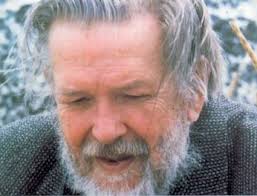
For me, as for many of my contemporaries, Canadian philosopher George Grant's Lament for a Nation (1965) was a crucial book. Ostensibly a lamentation over something finally and definitively lost - an independent Canada - the book paradoxically inspired nationalism and patriotism in a younger generation who came to see Canada with new eyes in the light of Grant's book. I continued to read Grant avidly after discovering Lament for a Nation, and many years later, in 1984, I found an opportunity to interview him for a series I was then preparing on the Loyalist roots of Canadian political culture. (Richard Cartwright and the Roots of Canadian Conservatism, Ideas, 1984) We got on, and I found him open to the idea I quickly proposed of a series devoted to his work. In 1985, along with recording engineer Rod Sneddon, I spent several invigorating days in conversation with him in his living room at 1622 Walnut St. in Halifax. Grant was expansive and spoke freely, sometimes dealing with subjects he had never treated in writing. I shaped three programmes from our edited conversations and presented them on Ideas early in 1986. A letter from Grant written later that year praising the "care and lucidity" with which I had "enucleated" his thought - a very characteristic word - remains a treasure. He died two years later. In 1995 a transcription of the entire interview was published by House of Anansi as George Grant in Conversation and remains available.
A friend remarked to me the other day that Grant is now nearly forgotten among the younger generations of Canadians. His appearance here is not likely to change that fate. but perhaps a few will respond to the continuing power of his witness. Grant wrote powerfully, if sometimes reluctantly, but speech was his glory, and I'm happy to to be able to present him here in full rhetorical flight...